The first piece published in Alumni Barta, the GCELT alumni e-magazine.
The two World Wars transformed Kolkata from a colonial entrepôt exporting raw hides into a centre of scientific leather production. Before 1914, India exported the overwhelming majority of its hides and skins to Germany and Austria, with little domestic tanning. The First World War severed these markets and created an urgent military demand for boots, harness, and saddlery. Kolkata, as the commercial and industrial capital of eastern India, became the epicentre of a state-supported effort to modernise leather production. The Calcutta Research Tannery, founded in 1919 on the recommendation of the Munitions Board, institutionalised this shift, and under the scientific leadership of Prof. Biraj Mohan Das, introduced chrome tanning and modern chemical methods. The Second World War accelerated this transformation, expanding the number of tanneries, stimulating indigenous manufacture of leather chemicals, and creating engineering firms to produce tanning machinery. This article traces the wartime history of leather technology in Kolkata from the export-oriented colonial economy through the institutional and industrial transformations wrought by two global conflicts.
The Pre-War Colonial Economy: Exporting Hides, Importing Leather
Before the First World War, Bengal’s leather economy was extractive rather than industrial. In 1913–14, the raw hides exported from Bengal alone weighed 1,302,490 maunds, while the weight of tanned hides exported was merely 13,153 maunds, a ratio of roughly one hundred to one. The Central European Powers, particularly Germany and Austria, took the greater proportion of these raw hides; it is estimated that before the war at least 60 per cent of the total export of raw hides went either to Germany or Austria.
The reasons for this neglect of domestic tanning were both economic and ideological. It was argued that the water of Calcutta was unsuitable for tanning, that tanning materials could not be obtained locally, and that the climate made tanning impossible. These assertions, as the Indian Munitions Board later noted, were examined and found to be largely unfounded. One of the first tanneries in India, John Teil & Co., had been originally established in Calcutta, and the city already possessed two chrome tanneries before the war: the Berhampore Tannery and the National Tannery. The National Tannery was already making its own chromate salts from raw ore obtained from mines in the Singhbhum district, indicating that the technical foundations for a modern industry already existed.
The First World War: Severed Markets and Military Demand
When war broke out in 1914, the Central European market for India’s raw hides vanished almost overnight. As the Indian Munitions Board’s Industrial Handbook put it: "When war broke out this market vanished. The world, however, must have leather, and it is inconceivable that these enormous supplies of raw materials should be allowed to be wasted". The military value of leather was recognised as a determining factor in warfare: "no army can fight without boots and harness, and the wastage in the field is enormous".
The market formerly offered by the Central Powers was largely replaced by England and her Allies, and large quantities of hides were exported for their armies. But England soon found that it could not tan the supply of hides being sent from India, and India was asked to extend tanning within the country. The cutting off of the Central European markets made domestic tanning a practical necessity.
The response was both private and governmental. The war eliminated German exporting firms and curtailed the export of raw hides and skins to Europe and America, giving an impetus to the development of the leather industry in India. By the time the war ended, there were already a few chrome tanneries working on a sound basis in Madras, Calcutta, Bangalore, and Cuttack.
The Calcutta Research Tannery: Institutionalising Wartime Necessity
The most enduring institutional consequence of the war was the establishment of the Calcutta Research Tannery in 1919, on the recommendation of the Munitions Board set up by the Government of India immediately after the First World War. The aim was to explore indigenous resources of hides, skins, and tanning materials for the production of leather and leather goods and the development of the leather industry in the country.
The founding of the Tannery was closely associated with Prof. Biraj Mohan Das (1885–1956), who had returned to India in 1914 just before the onset of the war. Das had trained at Leeds University under Prof. Procter, was a co-originator of the Das–Stiasny theory of chrome tanning, and was the first Indian leather technologist to earn a foreign degree. He joined the National Tannery in Calcutta in 1914, and the establishment of the Calcutta Research Tannery alongside the National Tannery enabled him to serve both institutions.
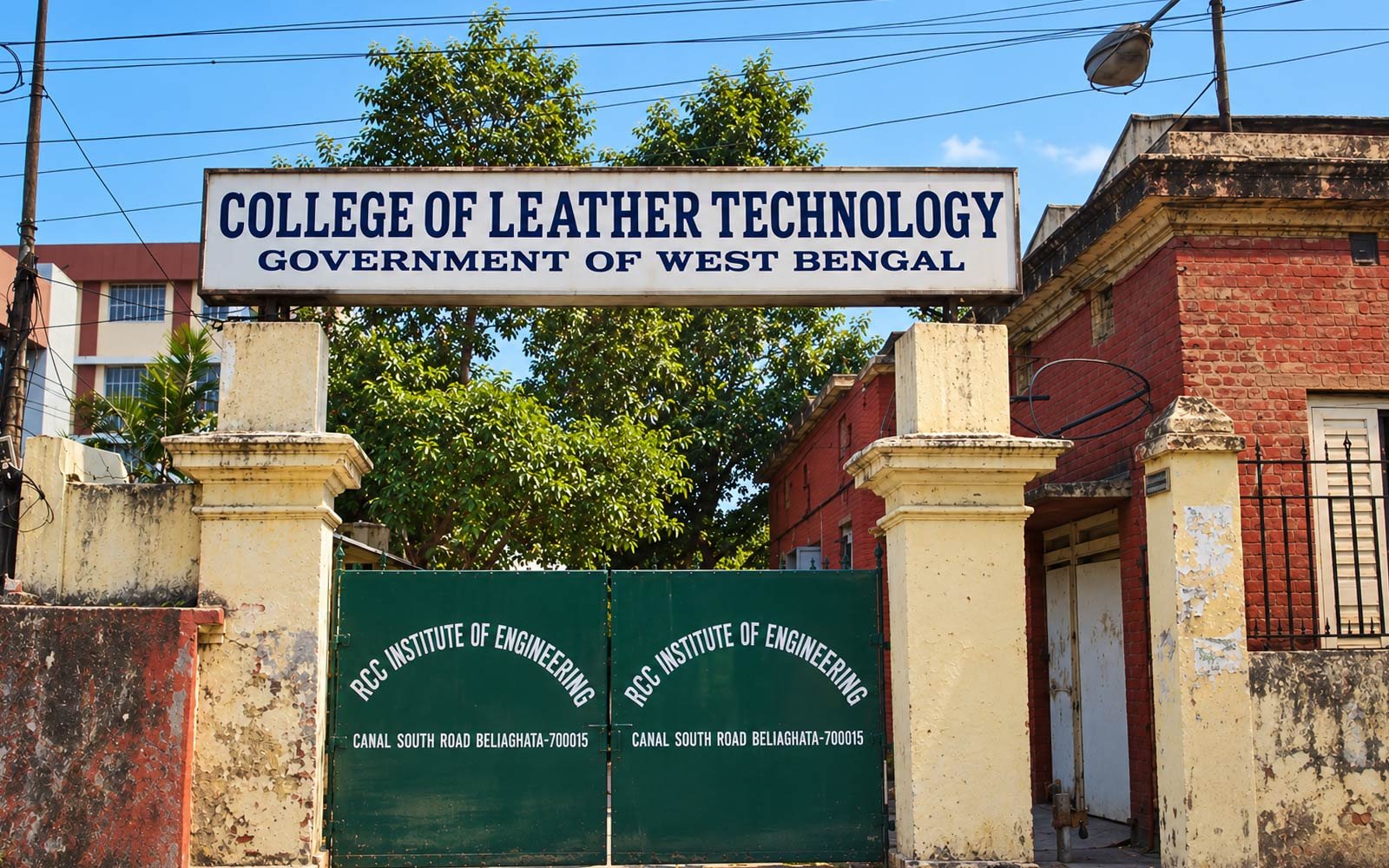
The Tannery was initially housed on Canal South Road, Beleghata, with about fifteen students. In 1924, it became the Bengal Tanning Institute, and in 1926 it was formally retained as a permanent institute under that name. The Institute’s object was to conduct investigations not only into methods for producing more important varieties of commercial leather but also into chemical problems connected with tanning.
Peripatetic Demonstration and the Dissemination of Chrome Tanning
The Institute maintained two peripatetic demonstration parties for disseminating knowledge of improved tanning methods among leather workers in the mufassil. Demonstrations were arranged at centres of indigenous tanning and at annual industrial and agricultural exhibitions held at district headquarters across Bengal. At Noakhali, for instance, the practical demonstrations by the Research Tannery staff helped village tanners produce better quality leather and shoes using the chrome process. This outreach work was instrumental in introducing modern tanning techniques to a dispersed artisan population that had previously relied on traditional vegetable tanning methods.
The Second World War: Industrial Expansion and Indigenous Innovation
The Second World War created a far more extensive transformation of Kolkata’s leather industry than the first. The advent of the war "again provided a fillip to leather industry to increase in demand for leather shoes and articles for the civil and military purpose". The entire output of India’s leather industry was increasingly sold to the military.
Expansion of Tanning and Production
The wartime demand led to a marked expansion of tanning in Calcutta. The National Tannery and the Calcutta Chrome Tannery, the two organised tanneries in Bengal, were mainly engaged in producing leathers for military purposes only. The Bata Shoe Co. Pvt. Ltd., originally started at Rishra in 1931 for rubber shoe business, started manufacturing leather shoes shortly after the war commenced and in 1940 started its own tannery, the entire production of which was consumed by the company itself.
Across the city, tanneries adopted improved chrome processes, and the daily output of chrome-tanned shoe upper leather rose from 50 pieces of cow hide and calf skin to 12,000 pieces.
Indigenous Manufacture of Leather Chemicals
The scarcity of imported leather chemicals, dyes, and auxiliaries during wartime created the opportunity for indigenous manufacture of items required for leather manufacture. The Bengal Chemical and Pharmaceutical Works Ltd. was the pioneer in making sodium bichromate. The Calcutta Chrome Tannery at Kanikara also started sodium bichromate manufacture for its own requirement during the war period. During 1943–45, new entrepreneurs started the manufacture of items that were previously imported. This import substitution marked a significant step toward technological self-reliance in the leather sector.
Indigenous Engineering and Tanning Machinery
The Second World War also stimulated the growth of light and heavy engineering industries connected to leather production. Some engineering firms were established for the manufacture of tanning machinery and equipment during wartime. The Bengal Machinery Co. and the Shalimar Engineering Works in Calcutta were pioneers in this field. The war thus created an integrated industrial ecosystem around leather, from raw hide processing through chemical manufacture to machinery production.
The Cost: Depletion of Livestock
The wartime expansion came at a heavy cost. The requirements of meat for the army were supplied from India, and the healthy and best qualities of cattle and buffalo were slaughtered to meet the demand. It is estimated that about 71 million cattle and 22 million buffaloes of superior quality were butchered during the war period, leaving India with only the inferior type of cattle and buffalo in 1945. After the war, raw hides became scarce, and the supply to tanneries came down considerably. The second blow came from the partition of India in August 1947, when about 40 million cattle and 8 million buffaloes went to Pakistan, making the scarcity more acute.
B.M. Das and the Scientific Basis of Wartime Leather Production
Prof. Biraj Mohan Das’s role in the wartime transformation of leather technology was central. He served as whole-time Superintendent of the Bengal Tanning Institute from 1934 to 1945. During this period, he was given the military rank of Colonel and deputed as an Expert in Leather Technology with the British Intelligence Objective Committee during the Second World War. He wrote the Bois Report, running into several pages, entirely from memory, based on what he observed during his visits to Germany during the War. The report was described as "a remarkable encyclopedia for a student of science to learn from".
In 1954, Das published "Leather: An Important Material for Defence" in the Defence Science Journal, a comprehensive article on the scientific principles underlying the manufacture of army leathers. He described how "the technology of the manufacture of army leather has followed the trend of general leather technology and has developed on scientific lines," noting that modern armies required leather footwear and kit suited to varied terrains and climates. The article detailed the specifications for sole leather, harness leather, and upper leather for army boots, and set forth the scientific principles involved in their manufacture.
Conclusion
The two World Wars were the decisive external shocks that transformed Kolkata’s leather industry from a colonial extraction economy into a modern, scientifically organised production system. The First World War severed the export markets for raw hides, created military demand for finished leather, and led to the founding of the Calcutta Research Tannery, the institutional seed from which GCELT grew. The Second World War expanded the number of tanneries, stimulated indigenous manufacture of leather chemicals, and created engineering firms to produce tanning machinery. Under the scientific leadership of B.M. Das, the Bengal Tanning Institute became the centre of a wartime effort to place India’s tanning industry on a modern scientific basis.
The legacy of these wartime transformations was ambivalent. On one hand, they created the institutional and industrial foundations of a modern leather industry, including the educational institutions that continue to train leather technologists. On the other hand, they depleted India’s livestock and left a post-war economy dependent on a raw material supply that was drastically reduced by partition. The wartime history of leather technology in Kolkata is thus a case study in how global conflict can catalyse technological modernisation while leaving lasting economic vulnerabilities.
Sources
- Indian Munitions Board Industrial Handbook 1919, Archive.org.
- Shodhganga thesis, Chapter 2: "The Government of Bengal retained the Calcutta Research Tannery as a permanent institute under the changed name of Bengal Tanning Institute."
- JILTA, June 2025, "The second world war created the opportunity of expanding and improving not only the tanning industries in India but also the chemical and light and heavy engineering industries."
- Shodhganga thesis, "But the advent of the Second World War, it again provided a fillip to leather industry."
- Shodhganga thesis, "Since the First World War, tanning and its associated industries had enormously increased in Calcutta."
- CLRI, "Tribute to a legendary, BM Das."
- Defence Science Journal, Vol. 4, No. 3, July 1954, B.M. Das, "Leather: An Important Material for Defence."
- CareerIndia, "Institutions that offer B.Tech in Leather Technology."
- Ei Samay, "শতবর্ষে চর্ম প্রযুক্তি কলেজ," 7 July 2018.